Saturday, 20 September 2014

Super Rugby and Beyond


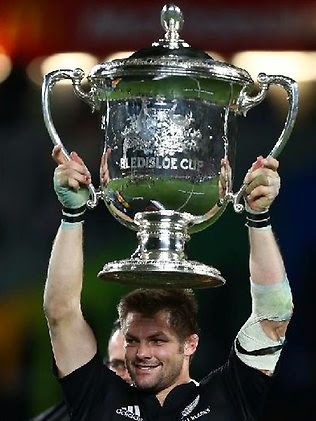
Richie McCaw holds the Bledisloe Cup (C) Getty Images
The final Bledisloe Cup match for 2014 is around the corner with the trophy already polished and placed at NZRU headquarters, and the Wallabies left to wonder what might have been had they taken the first game a month ago. The record defeat in Auckland on the 23rd of August left no doubt as to separation between the two sides, rendering the third game meaningless in deciding where the trophy is headed.


The hope created in the Autumn test series and the June Internationals had given the Wallaby fan-base some belief that the team was on track as the 7 game winning streak attested to, though it must be said only Wales and Ireland were truly class teams that Australia faced during that period. However they were secured, a win is a win is a win, and that is what the Wallaby fans care about most.

The returns thus far in the Rugby Championship have not been great, though you could excuse some of it to injury with various crises that the team has experienced in the back three and at hooker, as well as Queensland couple Quade Cooper and Will Genia being unavailable thus far. It would be a mistake however to use this issue as an excuse for a team that has struggled with simple decision making and basic skills. The hopes some Australian rugby union fans allowed themselves to indulge in after the Waratahs emerged victorious in this year’s Super Rugby competition had created heightened expectations and the side has struggled to perform at a similar level. Whether those hopes were reasonable or not to begin with remains to be seen.

Saturday, 16 August 2014

Public Service Announcement

Know Fear
While the game at Homestead may not have been as captivating as possible due to the rain, it did grant us the pivotal knowledge that the proud Juggalo gang has found refuge from persecution by moving to New Zealand and becoming rugby fans.

Juggalos: Never Die. 

The next Gathering will be in Auckland on Saturday, August 23rd.


Wednesday, 9 July 2014

Looking at the 2012 and 2013 Rugby Championships

Ben Smith takes on James O'Conner (c) Getty Images
Now that the June Tests have come to a close with series victories for the SANZAR squads, it is time to turn our attention to the Rugby Championship which outside of a World Cup/British & Irish Lions year is the premier event on the calendar. Sure, it does not have the history of the 6 Nations, but the quality of rugby is the highest you will find and anyone doubting that can please watch the Round 6 clash between New Zealand and South Africa for proof (here. You are welcome). The rugby is just flat-out awesome and I am already excited about what a competent Australia would mean to the competition and the progress Argentina will make as they continue to search for their first victory. I will not be making any predictions in this article, but what I do believe is that this year's tournament will be even better than last year, which truly is saying something. 


WIth an eye looking back to the last two years, I decided to have some fun by look at all the back-three starters (using Argentina's entry as the sensible point of reviewing data) to see which players were making the most of their carries: who had the highest average metres each time they touched the ball. I used the statistics from the Rugby Championship  site since I assume this is the official record, but I did notice some incongruities with their data and that from Statsguru, so I guess there could be some disputing the numbers. As this is a comparative project though, I do not believe that any difference would alter the overall picture these excel sheets paint.   

Saturday, 7 June 2014

ENG/NZ

Dan Carter takes on the English defence (c) GETTY Images
Ahead of the test series between England and the All Blacks there has been an understandable emphasis on a disparity of experience between the two sides. You would be hard pressed to come across a report previewing the match that does not highlight the collective cap totals of the starting XVs, and since the New Zealand team more than doubles their English counterparts (779-303), it is understandable that this feature has become part of the overall narrative of the series. 

If England lose Saturday, which they will, it is true that part of the reason will be because the All Blacks were more experienced and able to take advantage of a green England side. That the England team that won in 2012 was also vastly inexperienced compared to that Kiwi side hasn't been mentioned in what I've read.

What hasn't been talked about so much (maybe it doesn't need saying?) is that the Kiwis are collectively more talented and play superior rugby, which is why they will win the series. The England side for this week is missing a plethora of front line talent from injury and rest and had the XV that had featured for the previous 6 Nations been available, this gap in experience would not be the conversational crutch that it has become. The side is what it is though, and England coach Stuart Lancaster and his staff will have to construct a game plan that will give this side a chance at victory. 


Thursday, 10 April 2014

Munster v Toulouse, Part 1

Source: Patrick Bolger/Getty Images Europe
This past weekend the Heineken Cup quarter-finals were staged and there was fantastic rugby on display in all four matches with some of Europe's best club sides slugging it out. I won't go into the details of the matches for the sake of those that have not seen the games yet (YouTube!) nor will this be a column on one of the more remarkable incidents that completely altered the outcome of one of the matches (for the record, yellow card at most in my eyes). 

The Munster v Toulouse game (highlights) on Saturday was a fascinating affair because of the contrasting performances of the two teams, Munster carving deep holes in the Toulouse defence while the French side bumbled their way around the field offensively, shorn of a real attacking plan it seemed. The scores of the Irishmen were built up methodically, as they out-muscled a pack that was considerably larger than theirs and used a maul that walked at will. It was truly a match that showed Munster are a sum greater than their parts. 

I want to highlight today, in two parts to make them more digestible, the one try put up by Toulouse (around the 2:50 mark of the highlight package) because it was the complete personification of their performance and a classic symbol for what French rugby means to so many: a try from nothing. Watch that try, and we'll discuss what happened in the lead up and the break that led to the score.


Thursday, 3 April 2014

Some Thoughts based on 6 Nations penalty data

                                                             At its best                         (c) Getty Images
At the onset of the 6 Nations tournament when looking at some of the talking points for each team I discussed the penalty counts incurred last year and the impact that had for the respective sides. At the time I thought it would be interesting to look back once the Championship had concluded to examine the penalty count as a reflection of Referee performance. You often hear from the respective media of each nation that so-and-so don't like their country and always referee them harshly, and thought it would be interesting to see if there was any evidence of that during these 15 games.

Additionally, the last couple weeks of Super Rugby action has seen some terrible officiating recently that led to a discussion of relieving referees from their duties (which frankly should have happened but alas, another battle). There has been a lot of different debate about where to place the fault of these disputed contests: should it be on the players, who are committing infractions or is the referee and his interpretation wrong? Both sides have merit, poor officiating can have a disturbing effect on the direct outcome of a game, while players can also make poor choices.

The 6 Nations is a great spectacle because each match has the potential to be won by either side (even if it's a small chance) and because each point is valuable. Referees play a role in the outcome of matches, as their interpretation of each action . The point of this article though isn't to get bogged down in semantics about the intent of a referee, so let's look at some statistics!

Friday, 7 March 2014

Scotland: A Review

(c) PA Photos
"I talked about their game plan, their tactics, it's very difficult to see what they're doing" Jeremy Guscott on Scotland.

After watching the Scotland/England round 2 match-up I was very bothered by Scotland's performance because it felt like the first two rounds of the Championship at that time just ran so counter to the performances I remembered from last year. So I started to dig into the numbers a bit more and see just how delusional I had been about what happened last year.

In my 6 Nations preview for Scotland (here) I talked about their improved attack and scoring prowess in last year's tournament, and I was trying to be positive, but I wasn't looking or thinking about the whole picture at the time to understand the flaws in their game. I think as we have seen in their first three games in 2014, that positivity that was even there in the summer tour has mostly disappeared into a big team-wide malaise. Under Scott Johnson the team has secured some memorable wins and had the feeling of an improving side, but like his successor Andy Robinson those wins were built on the flawed performance of the other side (or their kicker *cough*Australia*cough*) and dogged defence by the Scots and when they got the result it was not often because they were the best side on the pitch.